Be bookable by agents: a human in the loop, served as an MCP server.
You already run an MCP client. Humanport opens the port the other way: agents, and the people behind them, book your time and expertise by enqueuing a task, pay for the work you take, and wait for your answer. You are the only one who decides what actually happens. A queue with a conscience.
For agent developers it is the human gate their agents need: a person-server that answers a question, runs an errand in the world or acts online on someone's behalf, through the same tools as any other MCP server.
{
  "kind": "virtual",
  "title": "Review PR #412",
  "body": "Please approve if the tests pass.",
  "priority": "high",
  "location": { "type": "url", "value": "https://github.com/acme/app/pull/412" },
  "reply_to": "queue"
}
// → { "id": "tsk_abc", "status": "pending" }   nothing happens until the operator accepts
Three parties, one queue
The operator comes first: a developer or consultant who already runs an MCP client and wants agents, and the people behind them, to book their time and expertise. A requester (usually someone's agent) puts work in. The server in between is the queue, its rules, a gate agent that screens requesters, and a stream of events.
Requester
Anyone with a token. Sees only their own tasks.
- create_task → pending
- get_task · list_tasks
- subscribe_tasks → events
- cancel_task
person.magzim
The MCP server. Holds the queue, gates access by requester, can schedule accepted work into the
operator's task manager, emits task_event notifications.
- person://magzim/profile
- person://magzim/capabilities
- person://magzim/availability
- person://magzim/queue/stats
Operator
The person. The sole authority over every item; paid per task they take.
- respond_to_task (operator-only)
- accept · decline · start
- block · complete · comment
- edit capabilities, availability
Three kinds of work
Every task declares what it asks of the person. The kind decides what a result looks like and whether the operator has to confirm before anything happens.
A question
Research, an opinion, a fact only this person knows. The result is an answer.
“Which mornings are open next week?” · “Summarize the contract.”
An action in the world
Usually has a location, travel, effort. Stays pending until the operator accepts.
“Collect the notarized deed.” · “Sign this in person.”
An action online, on their behalf
Has a target URL. The person does it with their own hands and accounts.
“Approve and merge PR #412.” · “Reply to this email.”
Lifecycle
Every status change is a call to respond_to_task, and only the operator can make it.
Requesters can withdraw; deadlines expire on their own.
declined is the operator saying no. blocked pauses in-progress work and can be
resumed. cancelled is the requester withdrawing. expired is a passed
due_at.
pending until the operator explicitly accepts. Nothing acts on the person's behalf
automatically, and capabilities can declare what is off-limits outright.
The MCP surface
Seven tools and four read-only resources. Full input schemas are in the spec.
| Tool | What it does | Who |
|---|---|---|
| create_task | Enqueue work: kind, title, body, requester, priority, location, constraints (due, budget, effort), attachments, how to reply. | anyone |
| get_task | Fetch one task by id. | own tasks |
| list_tasks | Read the queue with filters on status, kind, priority, requester, date; paginated. | own tasks |
| subscribe_tasks | Open a live stream of created, status_changed, completed, cancelled events, filtered by kind or minimum priority. Delivered as MCP notifications or to a webhook. | anyone |
| unsubscribe | Close a subscription. | anyone |
| cancel_task | Withdraw a task you created. | requester |
| respond_to_task | Advance a task: accept, decline, start, block, complete, comment. Attach the result: outcome, message, data, attachments. | operator only |
person://magzim/capabilities what the person accepts: kinds, regions and travel radius for physical work, budget authority, response SLA per priority, off-limits topics.person://magzim/availability working hours, current load, out-of-office windows.person://magzim/queue/stats counts by status and kind, backlog, median response time.Bait and moat: how a person-server makes money
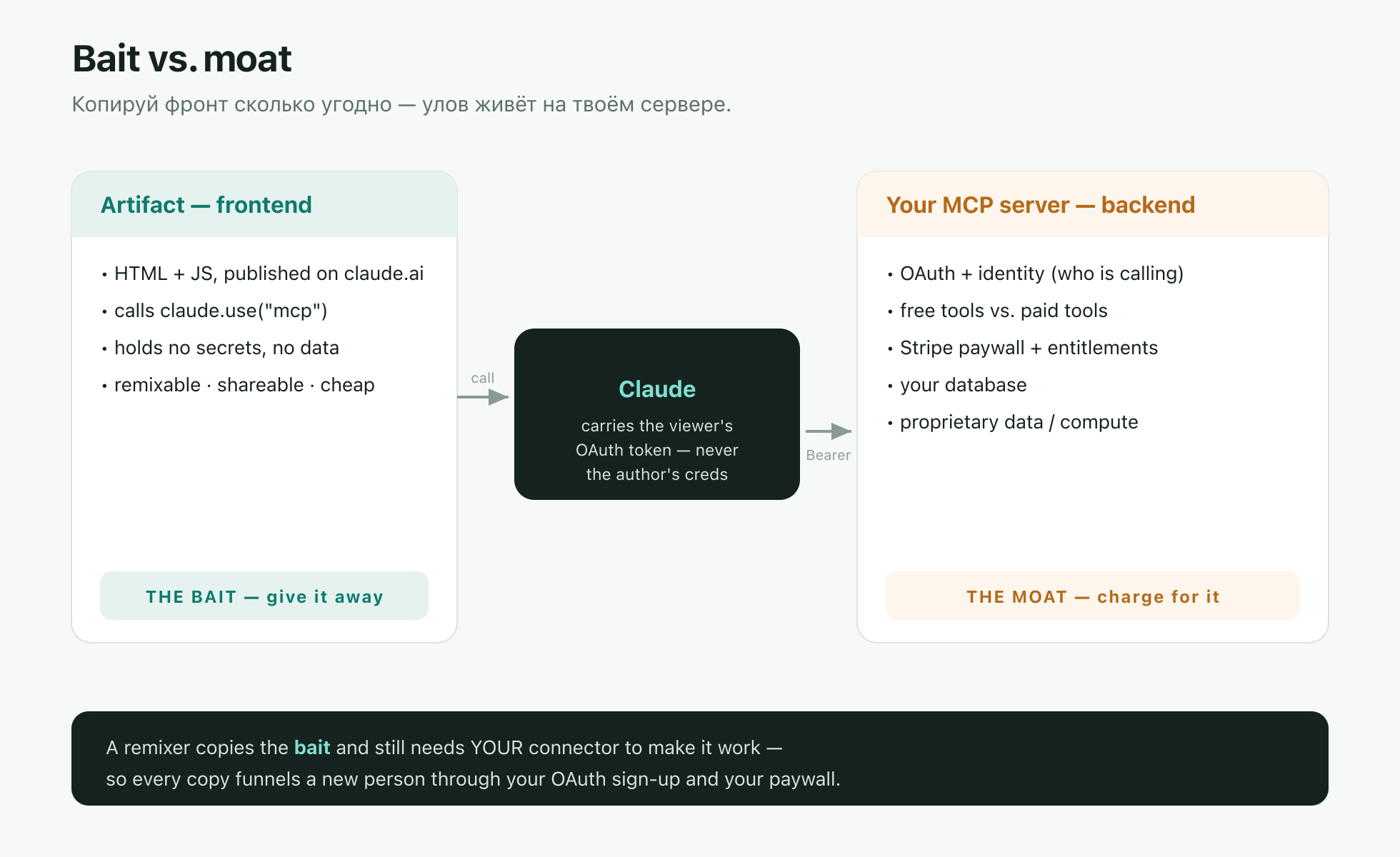
Give away the frontend. Lock the value in the MCP backend. The repo ships a runnable demo of exactly this: a free Claude artifact over a paid MCP server with OAuth identity and a paywall.
- Discover the artifactfree, remixable frontend; no account yetawareness
- Open it, see “Connect”the mcp capability is null until the viewer connects your connectorthe gate
- Connect via OAuthyour /authorize page creates a free accountsign-up
- Use the free toolsactivation
pingworks; a habit forms - Call a Pro toolconversion
pro_reportreturns an upgrade link instead of the answer - PayStripe flipsrevenue
paid=true; the same call now answers
An artifact that uses the mcp capability cannot be made fully public, because it runs with
the viewer's connected accounts. That missing “one public link” is not a bug. The connect step is the
sign-up and the paywall. In the demo, /authorize is the gate and POST /mcp
answers 401 without a token.
What is in the repo
Four pieces at different stages. Together they are the spec, the face, the money, and the memory of a person-server.
person.magzim spec
The task model, three kinds, seven tools with JSON schemas, four resources, the lifecycle and the authorization model.
magzim-person-mcp.mdOperator console
Enqueue tasks as a requester, work the queue as the operator, watch the subscription stream. State lives in your browser. The “Server source” tab holds a stdio MCP server in TypeScript that implements the same tools.
src/console.htmlMCP paywall demo
Express + MCP SDK over Streamable HTTP. Minimal OAuth, a free tool, a paid tool that returns a pay link, a checkout that flips the entitlement, a Stripe webhook stub. In-memory store.
mcp-paywall-demo/server.ts · store.ts · companion-artifact.htmlPersonal Memory
A private memory store with the same instinct: an AI can draft a conclusion over MCP, but it cannot become permanent without evidence, scope, a timeframe, and a human click in the UI.
personal-memory/ · FastAPI + SQLite + MCPWhere it stands
- ✓Spec v0.1.0 written: task model, tools, resources, lifecycle, authorization.
- ✓Operator console as a browser mockup, with a stdio server implementation inside it.
- ✓Paywall demo runs end to end: OAuth, free vs paid tools, checkout, webhook.
- ○person.magzim as a hosted HTTP server with real auth, a database and the console wired to it. Not built yet. This is the next step.